Most rooms ignore the ceiling, leaving it a blank white expanse. But a wood ceiling changes everything — it draws the eye upward, adds instant warmth, and makes a space feel grounded like a forest grove. Whether you choose rustic reclaimed barnwood, sleek cedar planks, or whitewashed shiplap, a wooden ceiling turns an ordinary room into a sanctuary. You’ll feel the difference the moment you walk in: the hush of natural texture overhead, the way sound softens, the feeling of being sheltered like a fawn beneath a canopy of pines.
These wood ceiling ideas will inspire you to look up. From living rooms with vaulted beam ceilings to bedrooms where a wooden lid cradles a chandelier, from dining rooms with rustic planks to cozy dens where the ceiling is the star, you’ll discover how wood transforms architecture into emotion. Like the roof of a canyon or the floor of a cathedral, a wood ceiling brings timelessness, texture, and a deep sense of shelter to any room in your home.
1. Cozy Media Room: Wood Ceiling Above a Well-Furnished Living Space
Settle into a living room filled with comfortable furniture, a flat-screen TV, and a warm wood ceiling overhead. In wood ceiling design, the ceiling adds acoustic warmth — it absorbs sound, making movie nights feel more intimate. You’ll appreciate how the wood tones soften the glare of the screen and make the room feel like a private cabin retreat, even in a suburban home.
A wood ceiling in a media room is both beautiful and practical. The wood helps dampen echo from surround-sound systems. Choose a medium-toned wood (like oak or hickory) that doesn’t reflect too much light. Add dimmable sconces on the walls to highlight the ceiling texture. The result is a space that feels luxurious and cozy — perfect for binge-watching or Sunday afternoon naps.
2. Hearth & Timber: Wood Ceiling Over a Fireplace Living Room
Gather around a crackling fireplace beneath a rich wood ceiling, and feel the ancient pull of shelter and warmth. This wood ceiling pairing is elemental — wood above, fire below, like a forest clearing with a campfire at its center. You’ll love how the ceiling’s grain echoes the fire’s flicker, making the whole room feel like a mountain lodge.
When combining a fireplace with a wood ceiling, consider fire safety. Use fire-retardant treated wood or maintain proper clearance. The wood ceiling should extend over the entire seating area, creating a cozy envelope. Add a stone fireplace surround to complement the organic materials. The room becomes a primal sanctuary — fire, wood, and the people you love.
3. Reflected Grandeur: A Large Mirror Beneath a Wood Ceiling
Hang a large mirror on the wall opposite a window, and let it reflect your wood ceiling. This clever wood ceiling trick doubles the visual impact — the mirror captures the grain and color, making the room feel taller and the wood more abundant. You’ll adore how the reflected light bounces off the wooden planks, creating a warm, golden glow throughout the day.
A mirror is a secret weapon in wood ceiling design. Place it where it will catch the ceiling’s reflection from a seated position. The duplicate wood pattern creates a sense of depth, like a forest mirrored in a still lake. This is especially effective in rooms with lower ceilings — the reflection tricks the eye into seeing more height.
4. Window-Framed Dining: Wood Ceiling Over a Bright Eating Space
Dine beneath a wood ceiling while looking out a large front window, and feel the connection between indoors and out. This wood ceiling placement makes the dining room feel like an indoor porch — the wood overhead mimics a tree canopy, while the window frames the real sky. You’ll love how the ceiling adds warmth to the white walls and chairs, making every meal feel special.
In a dining room, a wood ceiling creates intimacy for dinner parties. Choose a wood tone that complements your table. For a modern farmhouse look, use wide-plank pine. For mid-century, use walnut or teak. Hang a pendant light low over the table to draw the eye down from the ceiling, creating a cozy, well-proportioned space.
5. Bedroom Sanctuary: A Large Bed Beneath a Wooden Canopy
Sleep under a wood ceiling and feel the security of a forest canopy overhead. This wood ceiling idea turns a bedroom into a true sanctuary — the wood absorbs sound, regulates temperature, and adds organic texture that soothes the mind. You’ll appreciate how the ceiling makes the large bed feel cradled, like a nest in the branches of an old oak.
A wood ceiling in the bedroom should be in a calm, warm tone — avoid very dark woods that might feel oppressive. Consider whitewashed or light cedar for a airy, Scandinavian feel. Pair with soft linens, a wool rug, and natural light. The ceiling becomes the fifth wall of your sleep sanctuary, wrapping you in warmth as you drift off.
6. Chandelier & Timber: Elegant Dining Under Wood
Suspend a crystal or wrought-iron chandelier from a wood ceiling, and watch the contrast create magic. This wood ceiling pairing is classic: the roughness of the wood against the sparkle of the chandelier, like a starry sky glimpsed through pine boughs. You’ll love how the light plays across the wood grain, creating shadows that dance during dinner parties.
When hanging a chandelier from a wood ceiling, ensure the mounting box is securely attached to a joist. Use a chain or rod that complements both the wood and the fixture — black iron for rustic, brass for traditional. The chandelier should hang low enough to illuminate the table but high enough to not obstruct views across the room.
7. Fireplace Focus: Wood Ceiling Above a Hearth-Facing Seating
Arrange your living room furniture to face a fireplace, all beneath a continuous wood ceiling. This wood ceiling layout creates a conversation area that feels both intimate and grand. You’ll feel the way the ceiling draws the eye across the room, connecting the fireplace on one end to the seating on the other, like a river flowing toward a warm hearth.
For a fireplace-focused room with a wood ceiling, run the ceiling planks perpendicular to the fireplace wall — this visually widens the space. Add a large mantel that echoes the wood tone, and place a mirror above the fireplace to reflect the ceiling. The result is a room designed for lingering, where the ceiling plays a supporting role to the fire’s glow.
8. Statement Chandelier: Crystal Falling from a Wood Ceiling
Let a dramatic chandelier descend from your wood ceiling like a waterfall of light. In wood ceiling design, the fixture becomes jewelry against the organic backdrop. You’ll appreciate how the chandelier’s reflections play across the wood grain, creating a constantly shifting pattern of light and shadow, like sunlight filtering through leaves.
Choose a chandelier with scale — a wood ceiling can handle a larger fixture than a white drywall ceiling. Wrought iron, antler, or wood-and-metal fixtures feel right at home. For contrast, try a sleek modern chandelier in brass or glass — the juxtaposition is striking. Ensure the chandelier is centered in the room and hangs at the proper height (at least 7 feet above the floor).
9. Bedside Pendant: A Single Lamp Hanging from a Wood Ceiling
Hang a single pendant lamp on each side of the bed, suspended from the wood ceiling instead of using table lamps. This wood ceiling trick frees up nightstand space and adds modern drama. You’ll love how the cords drop vertically, echoing the vertical lines of the wood grain, like vines descending from a forest canopy.
For bedside pendants on a wood ceiling, hardwire the fixtures into junction boxes placed symmetrically. Use dimmable bulbs for bedtime reading. Choose shades that direct light downward — metal cones, glass globes, or fabric drums. The pendants become sculptural elements, turning your bedroom into a boutique hotel suite.
10. Light & Bright: Wood Ceiling with White Furniture
Pair a warm wood ceiling with crisp white sofas, shelves, and trim. This classic combination is a favorite in wood ceiling design — the white reflects light upward, keeping the space from feeling dark, while the wood adds organic warmth. You’ll adore how the contrast feels both fresh and timeless, like birch trees against a winter sky.
To balance a wood ceiling with white furniture, also use white or light walls. The wood becomes an accent rather than the dominant element. Add a few natural accessories — jute rug, leather chair, potted plant — to tie the palette together. The room feels Scandinavian in its simplicity but warmer and more inviting.
11. Reclaimed History: Barn Wood on the Ceiling
Install a ceiling of reclaimed barn wood, complete with nail holes, saw marks, and a century of patina. This wood ceiling choice brings instant character and a story into your home. You’ll love how the varied planks — some gray, some brown, some weathered silver — create a patchwork that feels like a forest floor turned upside down.
Reclaimed wood on a wood ceiling should be sealed with a matte finish to protect it while preserving the aged look. Use it in a den, library, or great room for maximum impact. The irregularities and imperfections are the point — each mark tells a story of a previous life. It’s the most environmentally friendly and soulful of wood ceiling options.
12. Full Immersion: Wood Ceiling Over a Fully Furnished Living Room
Fill your living room with comfortable furniture — sofas, armchairs, ottomans — all beneath a continuous wood ceiling. This wood ceiling approach makes the cozy feel even cozier. You’ll appreciate how the wood ceiling absorbs sound, muffling the clink of coffee cups and the rumble of conversation, creating a peaceful acoustic environment.
When your living room is full of furniture, a wood ceiling helps define the space without walls. Use a ceiling in a medium tone — not too dark to feel oppressive, not too light to disappear. Add recessed or track lighting to keep the room well-lit despite the wood’s natural darkness. The ceiling becomes the room’s anchor, holding all the activity below in a warm embrace.
13. Beam & Window: Wooden Beams Across a Sun-Drenched Living Room
Frame your living room with large windows and a set of rough wooden beams spanning the ceiling. This wood ceiling idea is both structural and decorative — the beams mimic traditional timber framing while letting in floods of natural light. You’ll love how the sunlight hits the beams, casting long shadows that shift throughout the day like the hands of a sundial.
Beams are a dramatic wood ceiling element. Use faux beams (hollow boxes) for a lighter look, or real timbers for authenticity. Paint or stain them to match your floor or furniture. Space them evenly, usually 4 to 6 feet apart. The beams add architectural interest and can hide wiring for lights or speakers.
14. Layered Comfort: Wood Ceiling Above a Lived-In Living Room
Live comfortably under a wood ceiling that has seen family game nights and lazy Sundays. In wood ceiling design, a lived-in feel is a compliment — the ceiling absorbs the warmth of daily life. You’ll appreciate how the wood hides minor imperfections and ages gracefully, like an old friend whose wrinkles are signs of a life well-lived.
A wood ceiling in a high-traffic living room should be durable. Choose a hard species like oak or hickory, and seal it with a clear, low-sheen finish. The ceiling will stand up to humidity from cooking and breathing, and it won’t show dust as easily as white drywall. Over the years, it will darken slightly, gaining a patina that tells the story of your home.
15. Minimalist Wood: Clean, Ready, and Serene
Keep your living room clean and uncluttered, letting the wood ceiling be the primary texture. This minimalist wood ceiling approach proves that less is more — the ceiling doesn’t compete with busy furniture or bright colors. You’ll feel the calm immediately, as if you’ve stepped into a Japanese tea house where every surface is intentional and peaceful.
A minimalist space with a wood ceiling relies on restraint. Use pale, wide planks in a light wood (ash, maple, or whitewashed pine). Keep walls white or pale gray. Choose furniture with clean lines and natural materials. The wood ceiling becomes a warm, grounding presence without overwhelming — a whisper, not a shout.
16. Pristine Potential: An Empty Room with a Wood Ceiling
Consider a nearly empty room with only a wood ceiling and a single piece of furniture. This architectural wood ceiling concept turns the room into a gallery for the ceiling itself. You’ll love how the wood grain becomes the art, the shadows its frame, and the emptiness a luxury that lets you truly see the texture overhead.
Not every room needs to be filled. In wood ceiling design, an under-furnished space highlights the architectural beauty. Use it as a meditation room, a yoga studio, or a simple entry hall. The wood ceiling will provide warmth and acoustic softness, turning a spare space into a sanctuary. Sometimes the most powerful design choice is what you leave out.
17. Vaulted Grandeur: Wood Ceiling & Wood Floors Together
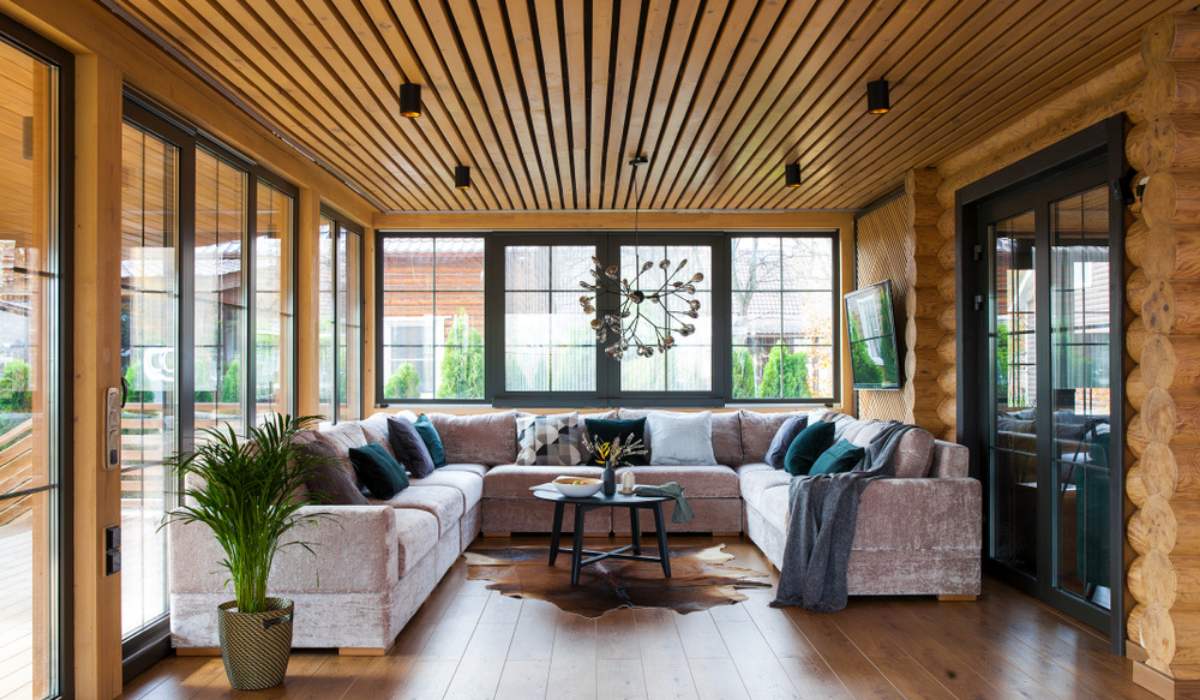
Match your vaulted wood ceiling with wood floors, creating a room that feels like a warm wooden cocoon. This wood ceiling strategy is bold but beautiful — the continuous wood surface wraps you in texture. You’ll feel like you’re inside a beautiful wooden boat or a modern treehouse, sheltered from the outside world.
When using wood on both the ceiling and floor, vary the tone and plank width to avoid monotony. Dark floors with a light ceiling create contrast. Use a large area rug to break up the floor. Add white walls on at least one side to give the eye a resting place. The result is dramatic but livable — a room that feels both grand and cozy.
18. Modern Pendant: A Single Light Dropping from a Wood Ceiling
Suspend a large, sculptural pendant light from your wood ceiling, and let it be the only fixture in the room. This minimalist wood ceiling lighting choice creates a focal point that draws the eye upward. You’ll appreciate how the pendant’s design — whether a paper lantern, a metal cone, or a woven rattan — interacts with the wood grain, creating a play of light and shadow.
When choosing a pendant for a wood ceiling, consider scale. A very large pendant (2-3 feet wide) can anchor a high ceiling. Use a dimmer to control the mood. The cord or chain should match the fixture’s finish — black for industrial, brass for traditional. The pendant becomes the room’s jewelry, and the wood ceiling is its elegant setting.
19. Breezy Comfort: A Ceiling Fan on a Wood Ceiling
Mount a ceiling fan on a wood ceiling, and enjoy both beauty and function. This wood ceiling addition keeps air circulating in summer and pushes warm air down in winter. You’ll love choosing a fan with wooden blades that match or complement the ceiling — the fan becomes part of the architecture rather than an eyesore.
For a wood ceiling, choose a fan with a low-profile or flush mount if the ceiling is low. If the ceiling is high, use a downrod to position the fan at an optimal height (8-9 feet above the floor). Look for fans with wooden blades in a similar stain to your ceiling. The fan will keep you comfortable while preserving the visual harmony of the wood overhead.
20. Dramatic Contrast: Wood Paneling Ceiling with Black Curtains
Frame a wood-paneled ceiling with floor-to-ceiling black curtains for a look that is moody, sophisticated, and deeply cozy. This wood ceiling pairing is for the bold — the dark curtains absorb light and make the wood feel even richer. You’ll feel like you’ve stepped into a mountain lodge or a Parisian library, where every element is chosen for drama and comfort.
When using black curtains with a wood ceiling, keep the walls a light color (white or cream) to prevent the room from feeling like a cave. The curtains should be velvet or linen for texture. Pull them back during the day to let in light, and close them at night for a cocoon of warmth. The contrast is striking — a wood ceiling never looked so glamorous.
🪵 Timber & Tranquility Guide: 5 Essential Pillars for a Wood Ceiling
- 🌲 The Color Echo Rule: Match or complement your wood ceiling with one other element in the room — the floor, the furniture, or a large picture frame. In wood ceiling design, repeating the wood tone somewhere below creates visual cohesion. For example, a walnut ceiling pairs beautifully with a walnut coffee table. The echo ties the room together like a refrain in a song, making the ceiling feel intentional rather than floating.
- 🪚 Plank Direction Matters: Run your wood ceiling planks perpendicular to your floor planks to create contrast and visual interest. If your floor runs north-south, run your ceiling east-west. In wood ceiling design, this perpendicular relationship makes each surface distinct while still harmonious. For a long, narrow room, run planks across the short dimension to make the space feel wider. The direction of your planks is like the current of a river — it guides the eye and affects the entire feel of the room.
- 💡 Light It Right: A wood ceiling can feel dark if not properly lit. Use a combination of recessed lights (aimed at an angle, not straight down), wall sconces, and table lamps. In wood ceiling design, avoid a single overhead fixture — it will cast unflattering shadows. Instead, layer light from multiple sources. The goal is to make the wood glow, not loom. Think of a forest canopy at golden hour — lit from the sides, warm and inviting, not harsh and shadowed.
- 🧺 Finish for Function: Choose your wood ceiling finish based on the room’s use. In kitchens and bathrooms, use a moisture-resistant sealant (polyurethane or marine varnish). In living rooms and bedrooms, a matte or satin finish reduces glare. In wood ceiling design, avoid high-gloss finishes — they create distracting reflections and show every imperfection. An unfinished or oiled ceiling is beautiful but high-maintenance. The right finish protects your investment while preserving the natural beauty, like a clear sky protecting a meadow.
- 📏 Scale the Planks: Wide planks (6-8 inches) make a room feel more rustic and expansive; narrow planks (3-4 inches) feel more refined and traditional. In wood ceiling design, match the plank width to your architecture. A modern cabin can handle wide, rough-sawn pine. A Victorian parlor needs narrower, smoother planks. The scale of your planks should feel proportional to the room — not too chunky, not too dainty, like the right-sized stones in a riverbed.
Frequently Asked Questions
Q: Is a wood ceiling expensive to install?
Ans: It varies widely. A DIY wood ceiling using tongue-and-groove pine planks can cost $3-5 per square foot. Reclaimed barn wood or custom milled walnut can cost $15-30 per square foot. Installation adds $3-8 per square foot if you hire a pro. In wood ceiling design, the most cost-effective option is often pre-finished pine or cedar planks. Consider doing just one room (like a living room or master bedroom) to control costs. The warmth and value a wood ceiling adds to your home often outweighs the initial expense — it’s an investment in beauty and comfort.
Q: Can I install a wood ceiling over existing drywall?
Ans: Yes — in fact, most wood ceiling installations go directly over drywall. Use a nail gun with proper length nails to penetrate through the drywall into the ceiling joists. This method adds minimal weight and avoids demolition mess. For a wood ceiling over drywall, ensure your joists can support the extra weight (wood is heavier than drywall). If you’re concerned about weight, use lighter wood species (cedar, pine) or faux beams. Covering drywall with wood is a transformative upgrade that doesn’t require tearing out your existing ceiling.
Q: How do I clean and maintain a wood ceiling?
Ans: Regular dusting is key — use a soft brush attachment on your vacuum or a microfiber mop. For a wood ceiling, avoid water or spray cleaners, which can damage the finish. Instead, occasionally wipe with a barely damp cloth followed by a dry one. Re-coat with sealant every 5-10 years depending on wear. In kitchens, clean more frequently to prevent grease buildup. A well-maintained wood ceiling will last decades, darkening gracefully and gaining a beautiful patina. The small effort of dusting every few months preserves its warmth and beauty.
Q: Will a wood ceiling make my room look smaller or darker?
Ans: Not if done thoughtfully. A light-colored wood ceiling (whitewashed pine, light oak, bleached ash) reflects light and can make a room feel taller. Darker woods create coziness and intimacy. The key is lighting: a well-lit wood ceiling never feels oppressive. In wood ceiling design, also consider wall color — pale walls keep the room airy. A wood ceiling in a room with ample natural light feels warm, not dark. It’s like a forest: some parts are shadowy, but the overall feeling is sheltering, not claustrophobic.
Q: What’s the best wood species for a ceiling?
Ans: For a classic wood ceiling, pine and cedar are affordable and easy to work with. Pine takes paint and stain well; cedar is naturally moisture-resistant. For a modern look, use oak or walnut for richer grain. For a rustic, weathered appearance, reclaimed barn wood has unmatched character. In a bathroom or kitchen, choose a moisture-resistant species (cedar, teak, or ipe). In wood ceiling design, your choice should balance budget, desired look, and the room’s conditions. The best wood is the one that makes you look up and smile every time you enter the room.
Conclusion
You have journeyed upward, through rooms crowned with warm wood, rough beams, and vaulted planks. Each wood ceiling image whispered the same truth: the fifth wall deserves as much attention as the other four. Like the canopy of an old-growth forest, a wood ceiling shelters, warms, and connects us to nature — even in the heart of a city. It turns a house into a haven, a room into a retreat, and a simple act like looking up into a moment of quiet wonder.
Now it is your turn to raise your eyes and imagine. Go find a wood species that speaks to you — the pale serenity of ash, the rugged soul of reclaimed barnwood, the golden warmth of cedar. Consider the direction of your planks, the fall of your light, the finish that will protect for decades. Your wood ceiling is waiting to be installed, to transform your living room, bedroom, or dining space into a sanctuary of timber and tranquility. Look up, dream, and build. 🌲🏠✨